

 CN
 EN

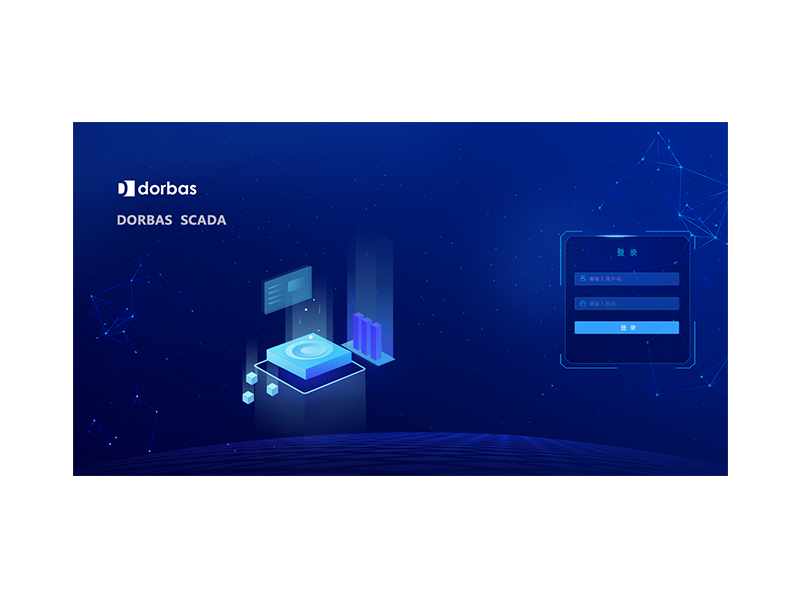
SCADA Integrated Monitoring Software
SCADA is an integrated monitoring and configuration software for industrial automation and intelligent building sectors. It delivers full capabilities including project configuration, data acquisition, process graphic monitoring, trend analysis, alarm management and historical data storage. The software supports multiple deployment modes such as standalone, C/S and B/S architectures. It can work in conjunction with large real-time/historical databases and data collectors, flexibly adapting to projects of various scales ranging from small standalone stations to large redundant systems.
Core Features
Flexible Deployment Options: Supports standalone, C/S and B/S architectures. Network nodes can be distributed across different network segments. Dual-server hot standby is available with automatic failover upon server failure to ensure uninterrupted system operation.
Integrated Configuration Toolchain: Tools for project management, system architecture configuration, database management, flowchart drawing and trend configuration work in coordination. Projects are centrally stored on the configuration server, supporting one-click release of the full project and synchronous updates across multiple nodes.
Comprehensive Data Processing: Three database modes are available: local database, enterprise database and hybrid database. It implements real-time data acquisition, historical data archiving, alarm generation and logging. Built-in simulation drivers support simulation and commissioning in early project stages.
Visual Monitoring and Analysis: Customizable process flow diagrams bind tags to display real-time device status. Real-time and historical trend curves are provided, together with complete alarm management including alarm viewing, acknowledgement and partition management.
Operation Access Control: Different monitoring views and permissions are assigned to users via operation groups. Trend screens, flowchart pages and alarm partitions can be configured to achieve hierarchical management.
Product Interface
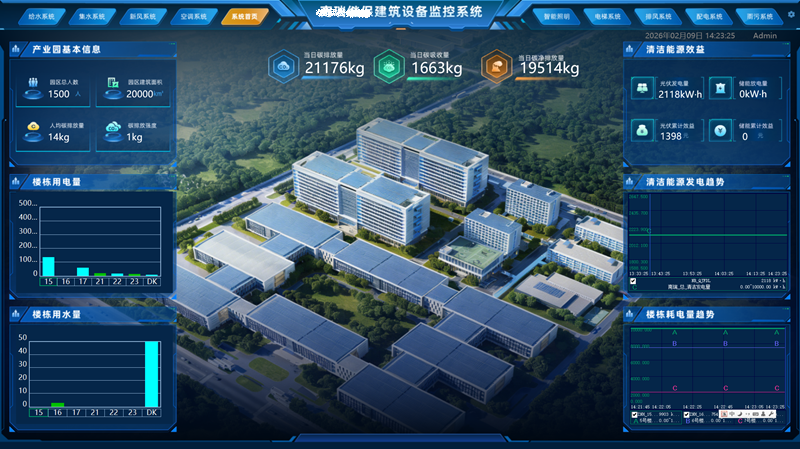
Daily Carbon Sequestration: The daily carbon sequestration value displayed on the system homepage is automatically calculated by a preset algorithm model based on clean energy data such as actual power generation of the photovoltaic power system and discharge capacity of the energy storage system, to measure the carbon offset and environmental contribution of the park on the day.
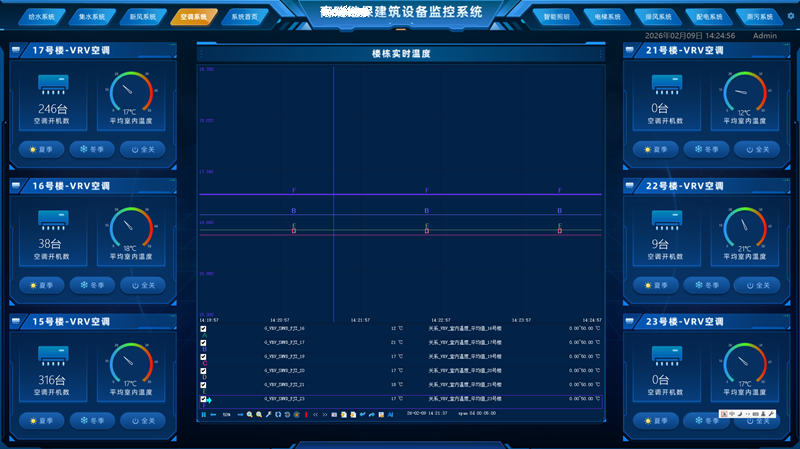
Air Conditioning System Operation Instructions: Click the building number to access the corresponding floor page for refined air conditioning parameter settings. Three batch control modes are supported: summer cooling (default recommended 26℃), winter heating (default displayed 32℃, recommended 26℃, adjustable), and full-unit shutdown.
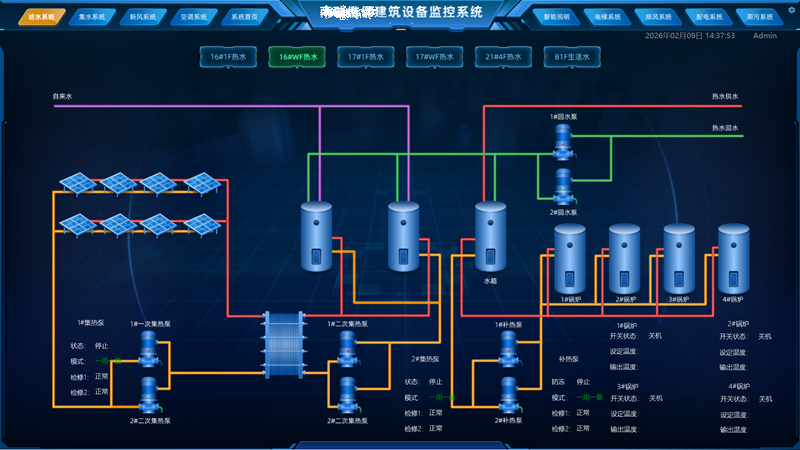
Water Supply System Operation Instructions: Key monitored areas include: hot water supply system on the 1st floor of Building 16, hot water supply system on the top floor of Building 16, hot water supply system on the 1st floor of Building 17, hot water supply system on the top floor of Building 17, hot water supply system on the 4th floor of Building 21, and domestic water supply system in the basement. All monitoring data displayed here are obtained in real time from third-party connected systems through system interfaces to guarantee data accuracy and timeliness.
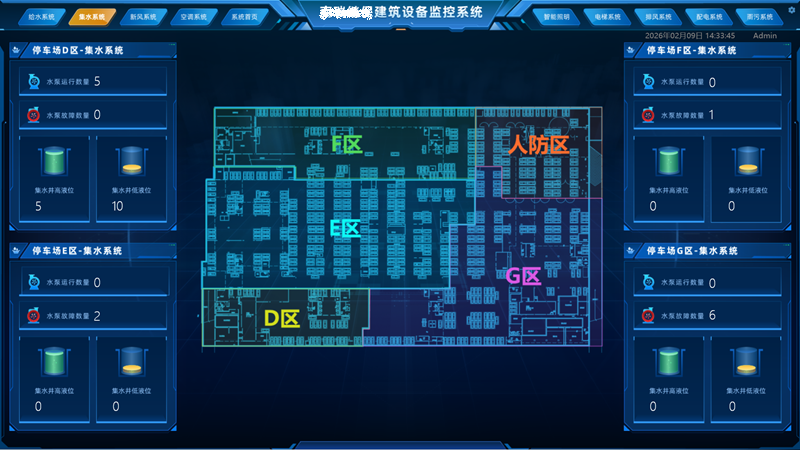
Water Collection System Operation Instructions: Area navigation codes: Users can select via the area navigation codes on the interface to directly enter the corresponding sump control area page for monitoring and operation of water collection equipment in this area.
Technical Specifications
|
Item |
Description |
|---|---|
|
Deployment Architecture |
Standalone Monitoring / C/S (Server + Operator Station) / B/S / Redundant Server |
|
Database Mode |
Local Database / Enterprise Database (InPlant Historian) / Hybrid Database |
|
Operating System |
Windows 10 Enterprise 2019 LTSC (64-bit Simplified Chinese) |
|
Windows Server 2019 Standard (64-bit Simplified Chinese) |
Application Scenarios
Suitable for centralized monitoring of industrial production processes, factory equipment status collection and alarm tracing, comprehensive equipment monitoring for intelligent buildings and large structures, as well as various automated monitoring projects requiring redundant hot standby and high-reliability operation.

