

 CN
 EN

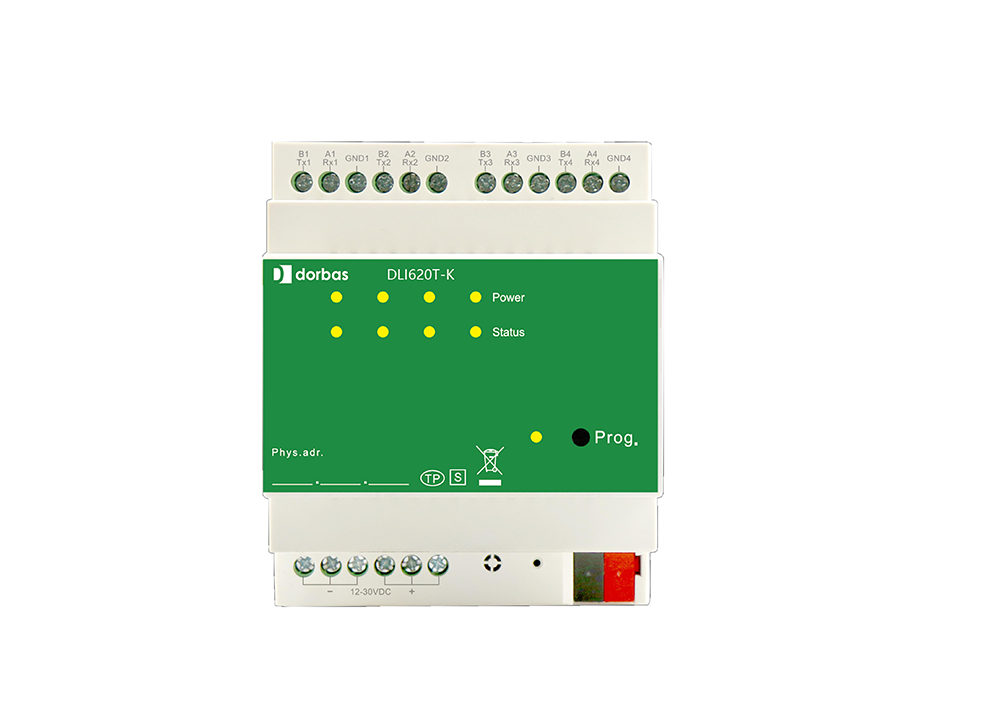
KNX Modbus Cascading Gateway
DLI620T-K
The DLI620T‑K is a bidirectional protocol conversion gateway between KNX and RS485 (Modbus). Serving as the communication interface between KNX/EIB bus and RS485 bus, it enables mutual message conversion and two-way communication between KNX devices and RS485 devices.
Powered by the KNX bus and mounted on a standard 35mm DIN rail, it supports customizable serial port parameters and message formats. It can handle up to 512 bidirectional message conversion rules and configure byte increment/decrement for 256 groups of KNX messages. It meets the requirements for data exchange and linkage control between KNX systems and Modbus‑RTU peripherals in intelligent buildings, and is widely used for interfacing and integrating different bus systems in building intelligent control projects.
- Supports custom RS485 communication interface protocol and serial port configuration;
- Transmit and receive control messages configured via host computer software;
- RS485 messages support lengths from 1 to 64 bytes with customizable message format;
- RS485 messages support ACK response, length from 0 to 32 bytes with customizable message format;
- Enables mutual conversion between RS485 bus messages and KNX bus messages for bidirectional control;
- Up to 512 conversion rules for RS485-to-KNX and KNX-to-RS485 messages;
- RS485-to-KNX message supports 1-byte KNX message offset adjustment, up to 256 configurable groups
- Bus Voltage: 21-30 VDC, powered by KNX bus
- Bus Current: ≤12mA
- Operating Power Consumption: ≤2.3W
- Operating Temperature: -5℃…+45℃
- Storage Temperature: -25℃…+55℃
- Transport Temperature: -25℃…+70℃
- Relative Humidity: Max 90%
- Housing Material: PA66
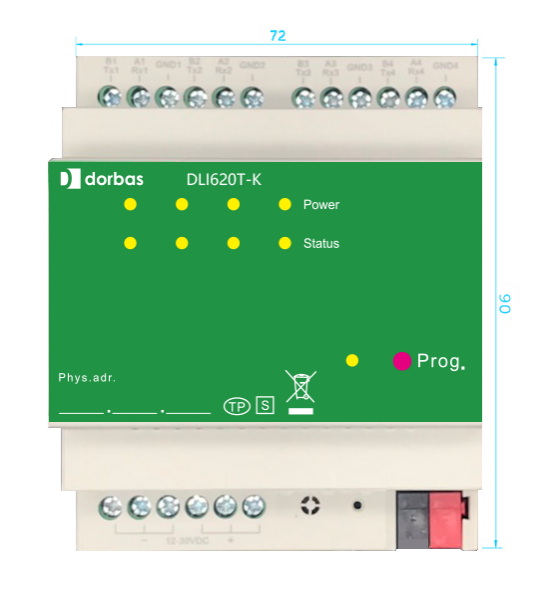
- Dimension (W × H × D): 36mm × 90mm × 64mm
- Mounting Method: 35mm DIN rail mounting
(1) Read all instructions carefully before use.
(2) Maintain a well-ventilated environment.
(3) Protect against moisture, vibration and dust during operation.
(4) Do not expose to rain, other liquids or corrosive gases.
(5) Dry the device promptly if it gets wet or contaminated by liquid.
(6) Contact professional maintenance personnel or our company in case of equipment malfunction.

